Woodcut tattoo: history, aging and size
A woodcut tattoo takes its look from relief prints such as Albrecht Dürer's 1515 Rhinoceros: black lines and hatching, with white left wherever the block was cut away. Tone comes from lines instead of soft shading, so the size you choose and the spacing of those lines decide how clearly it reads as it ages.
A dated history of the woodcut look
On 20 May 1515 an Indian rhinoceros arrived in Lisbon. It was the first living rhinoceros seen in Europe since Roman times. Albrecht Dürer never saw it. He worked from an anonymous written description and a brief sketch, and from those he made the image people still picture when they hear "woodcut": an animal covered in hard plates like armour, with a small twisted horn on its back. A real rhinoceros has neither.
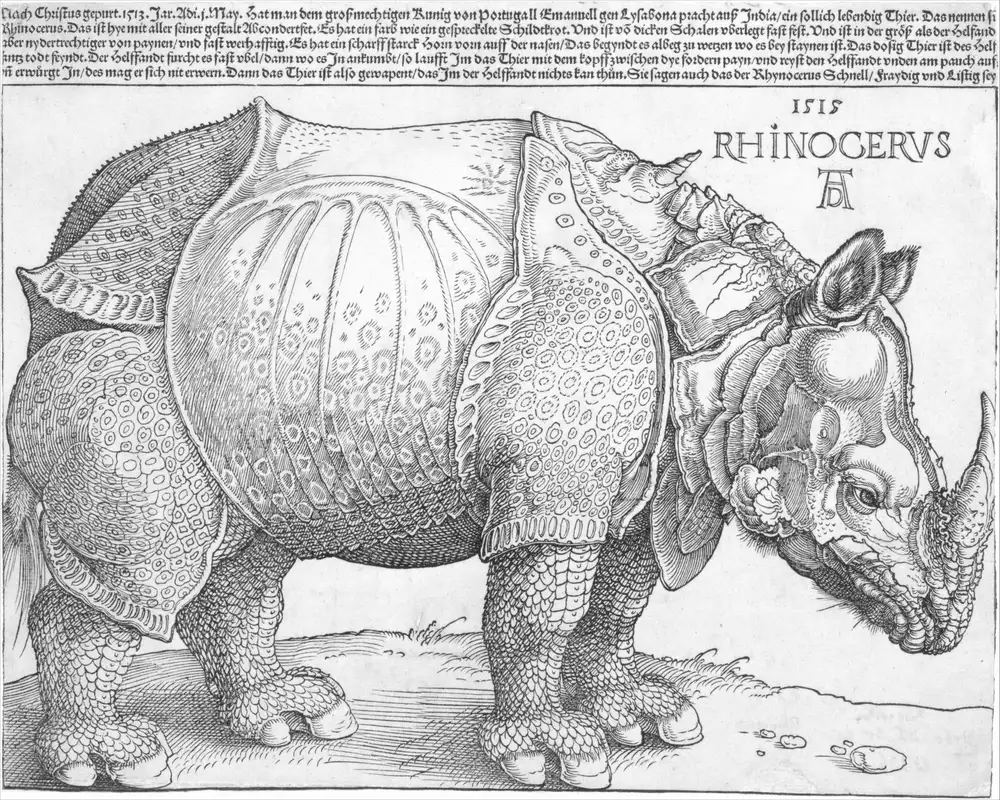
Dürer drew the design, and someone else cut it. The block was cut by a specialist craftsman, a Formschneider, possibly Hieronymus Andreae. Keep that division of labour in mind when you look at the print, because every line in it is wood the cutter chose to leave standing.
The animal itself was lost. King Manuel I sent it as a gift to Pope Leo X, and it died when the ship went down in a storm off the coast of Italy, near Porto Venere. The print lasted far longer. Into the late 18th century, Europeans took Dürer's rhinoceros as a true picture of the animal, plates, twisted horn and all. The Metropolitan Museum of Art holds an impression of The Rhinoceros, 1515, and it is in the public domain.
Tattooers picked up the language of old prints much later. Thomas Hooper, from Hastings in the UK, has tattooed since 2000. The Creative Independent describes him as a leader of modern blackwork tattooing, and he lists "traditional woodcuts and mystic cosmology" among his inspirations. CO:CREATE's list "11 Engraving Tattoo Artists You Should Know" shows how far the print vocabulary has spread since, with artists in Milan and New York City working from engraving, etching and printmaking.
What a woodcut is, and what an engraving is
The two words get swapped all the time, but the prints behind them were made in opposite ways.
A woodcut is relief printing. The artist cuts away every part of the block that should not print, and the raised surface left behind takes the ink. A woodcut needs only low pressure to print, and it is cut along the grain of the wood. Wood engraving, its close relative, is cut into the end-grain instead.
An engraving works the other way round. The engraver uses a burin to cut grooves into a plate, usually copper, and the plate is printed by intaglio. So in a woodcut the line is the wood that stayed, and in an engraving the line is the groove that was cut.
That difference explains the woodcut look. The white is what was cut away, so every white shape was a decision, and tone comes from lines and hatching instead of shading. A woodcut rose has no grey wash. Its petals turn because the lines thicken, thin, cross or stop. Tattoos in the style carry this over: black line, open ground, and hatching where a painter would shade.
In tattooing the labels are used loosely. CO:CREATE's engraving list includes Marco Matarese, who specializes in engraving and etching tattoos, and Maxime Plescia-Buchi, who works through printmaking-inspired techniques. When you talk to a tattooer, bring pictures of the look you want, since one artist's "woodcut" may be another's "engraving".
How a woodcut tattoo ages, and how big to go
Every tattoo line spreads a little with time. Ray Studios puts it plainly: "Over the years, a very fine line can double in width, without the tattoo being considered a failure." The same studio names fine-line tattoos as the most vulnerable to ageing, and says ink set too deep spreads in the dermis and widens lines.
For a woodcut design this matters more than for most, because the drawing lives in its gaps. Hatching is lines laid close together with white between them. As each line widens, the white between them narrows, the shaded area goes darker, and tight hatching can close up into a flat black patch.
Tattooers commonly answer this in two ways: space the lines further apart, and go bigger so the gaps have room to lose some width. That is advice, not data, though it follows from how the style is built.
Take one woodcut at 5 cm and again at 12 cm: at 12 cm every line and every gap is 2.4 times as wide, and the design covers almost six times the area. The 5 cm tattoo and 12 cm tattoo pages go into each size in more detail.
To judge your own design, find its tightest hatching, where the lines sit closest, and picture those lines a little wider years from now. If the gaps would vanish, the design wants more size, fewer lines, or both. That is a rule of thumb drawn from the ageing advice above.
Where to put a woodcut tattoo
A woodcut design is usually a picture with a top and a bottom, like a print on a page, so it wants a spot where it can sit upright and be seen whole.
The forearm is the natural first choice. The outer forearm holds a single upright image and is easy to show or cover. A wider design, such as an eagle with spread wings, suits the chest, where both wings can open across the body. The back has the most room of all, enough for a full scene in the manner of an old print, with hatching that stays open at a large size.
plan.tattoo puts your design on a 3D plaster cast at the size you type in cm. You can turn the cast, move the design to another placement, try it on another cast, or use a posable figure to see how a bent arm changes the view. It is free, runs in the browser, and you can try it without an account.
The woodcut samples in plan.tattoo come from old prints. The rose is public domain, from the Noord-Hollands Archief, and the eagle comes from the Wellcome Collection under CC BY 4.0. Full credits are on the samples credits page. For a very different kind of black line, see the cybersigilism tattoo page.
Tattooers who work from prints
The Creative Independent profiles Thomas Hooper, who comes from Hastings in the UK, has tattooed since 2000 and works at Rock of Ages in Austin, Texas. It calls him a leader of modern blackwork tattooing, and he names traditional woodcuts among his inspirations.
CO:CREATE lists Marco Matarese, in Milan, as specializing in engraving and etching tattoos, and Maxime Plescia-Buchi, in New York City, as working through printmaking-inspired techniques. Both appear in its "11 Engraving Tattoo Artists You Should Know".
These names come from those two sources and make no claim to be a complete list. Look through each artist's own portfolio before you book, and check that the line weight and spacing in their healed work match what you want.
Questions
What is a woodcut tattoo?
A woodcut tattoo is a black design drawn to look like a relief print, the kind made by cutting away a wooden block so that its raised surface takes the ink. It builds tone from bold lines and hatching and leaves open white areas where a printer would have cut the wood away. Albrecht Dürer's 1515 Rhinoceros is the best-known example of the look.
Do woodcut tattoos age well?
They can, if the design has room. Ray Studios notes that a very fine line can double in width over the years without the tattoo being considered a failure, and that fine-line work is the most vulnerable to ageing. Woodcut tattoos depend on the gaps in their hatching, so tattooers commonly advise spacing the lines and going big enough. That is advice, not data.
Woodcut vs engraving tattoo: what is the difference?
The names come from two printing methods. A woodcut is relief printing: the artist cuts away what should not print, along the grain of a wood block, and the raised surface takes the ink. An engraving is cut as grooves with a burin, usually into a copper plate, and printed by intaglio. Tattooers use both labels loosely, so show your artist pictures of the look you want.
How big should a woodcut tattoo be?
Big enough that its tightest hatching keeps visible gaps once the lines spread. No source gives a fixed number, and the common advice to go bigger is advice, not data. Compare one design at two sizes instead: going from 5 cm to 12 cm makes every line and gap 2.4 times as wide. Type both sizes into plan.tattoo and turn the plaster cast to see the difference.
Sources: Wikipedia: Dürer's Rhinoceros · Wikipedia: Woodcut · Wikipedia: Engraving · The Metropolitan Museum of Art: The Rhinoceros, Albrecht Dürer, 1515 · Ray Studios: Why some tattoos blur over time · The Creative Independent: Thomas Hooper · CO:CREATE: 11 engraving tattoo artists you should know
Open the planner, pick the rose in the samples and type 12 in the size to see the woodcut at 12 cm, then type 5 and compare.