Cybersigilism tattoo: origin and placement
Cybersigilism is a tattoo style of long, spearlike lines, symmetry and tribal-like patterns drawn with cyberpunk precision. Its name is usually credited to the artist Aingelblood. It grew from neo-tribal tattooing, generally credited to Leo Zulueta, mixed with Y2K graphics and H.R. Giger's biomechanical art, and its fine lines make size and placement matter.
A dated timeline of cybersigilism
The oldest idea the style is linked to comes from 1913. That year Austin Osman Spare set out a sigil method in The Book of Pleasure: write down an intent, remove the repeated letters, form a glyph from what is left, charge it, then forget it. Tattooswizard draws the line from Spare to the style, and also notes that most cybersigilism writing doesn't connect the two, so treat it as one writer's reading.
The tattoo history starts in the late 1970s, when tribal tattooing took root in the US, according to the Grand Rapids Art Museum. Its exhibition "Black Waves: The Tattoo Art of Leo Zulueta" says Zulueta has tattooed his own clients since 1981. Don Ed Hardy encouraged him to study Pacific designs, and he drew on work from Samoa, Micronesia, Borneo, Fiji and the Marquesas. The museum calls him a pioneer of tribal tattooing, and Tattooswizard says he is generally credited as the father of modern neotribal tattooing.
Tattooswizard lists the other things that fed into it: Y2K graphics with chrome text, holographic gradients and tribal-flame clip art; H.R. Giger's biomechanical surrealism; and the thorn-like extreme-metal logos of Christophe Szpajdel, which artists cite.
In the late 2010s, by Tattooswizard's account, the style grew out of Berlin's club and rave scene. Underblast credits Aingelblood (A.i., @cybersigilism) as the first to use #cybersigilism and as the style's originator, and says Aingelblood went viral on TikTok in 2020. Tattooswizard also credits the name to Aingelblood, an artist at Sekret Ink in Los Angeles. Miami New Times, writing in 2024, places the origin about four years earlier in New York City's tattoo scene. With three accounts in print, this page says the name is usually credited and leaves it there.
By the early 2020s, Tattooswizard writes, artists in Seoul, France, Argentina, Berlin, Mexico City and Amsterdam were recognisably working in the style. On 13 January 2023 The Daily Beast, in a piece by Helen Holmes, called it tattooing's biggest trend. In 2024 Miami New Times reported the critics' side: some call it a fad or the work of "scratchers", poorly done tattoos by the inexperienced, and doubt how it will age.
In May 2025 Dazed, in a list by Tiarna Meehan updated in February 2026, described the style as "dubbed Gen Z's answer to Gen X's tribal tattoos and Millennial's infinity loops". On 23 May 2025 Underblast set it beside eurotrash in "Underground Tattoo Takes Over the World: Eurotrash vs. Cybersigilism".
Fashion and music carried it along. Tattooswizard points to runways at Vetements and Balenciaga, to Drain Gang, Sad Boys and Playboi Carti, and to visible tattoos on Billie Eilish and Grimes. Underblast says Noel Garcia tattooed Grimes and played a major part in the style going mainstream.
What cybersigilism is, and how it differs from eurotrash
The Daily Beast's piece on the trend describes "long, spearlike lines", symmetry and "tribal-like patterns" with "cyberpunk precision". The work can look like armour, like veins, or like "a lattice of tributaries flowing into a river". Dazed, citing its own 2022 coverage, has called it "post-human or nu-tribal".
Eurotrash comes up in the same conversations, and Underblast describes it as "a new genre born in the Europe underground tattoo scene": chaotic, sketch-style blackwork with medieval and surrealist imagery. Put the two descriptions together and the split is clear. Cybersigilism, as The Daily Beast's piece describes it, is symmetrical and precise. Eurotrash, as Underblast describes it, is chaotic and sketchy and built around medieval and surrealist pictures.
Neo-tribal tattooing is a third thing again. Zulueta's work drew on Samoa, Micronesia, Borneo, Fiji and the Marquesas, and Dazed frames cybersigilism as Gen Z's answer to Gen X's tribal tattoos, a successor to that work and a different style from it.
The samples filed under cybersigilism in plan.tattoo are public-domain neo-tribal designs from openclipart. They stand in for the tribal look the style grew from, and none of them is a cybersigilism piece. To see a real cybersigilism design at its size, add your own image of one in the designs panel.
How cybersigilism ages, and how big to go
The style lives on fine lines, and fine lines change the most. Ray Studios says "Over the years, a very fine line can double in width, without the tattoo being considered a failure", names fine-line tattoos as the most vulnerable to ageing, and explains that ink set too deep spreads in the dermis and widens lines.
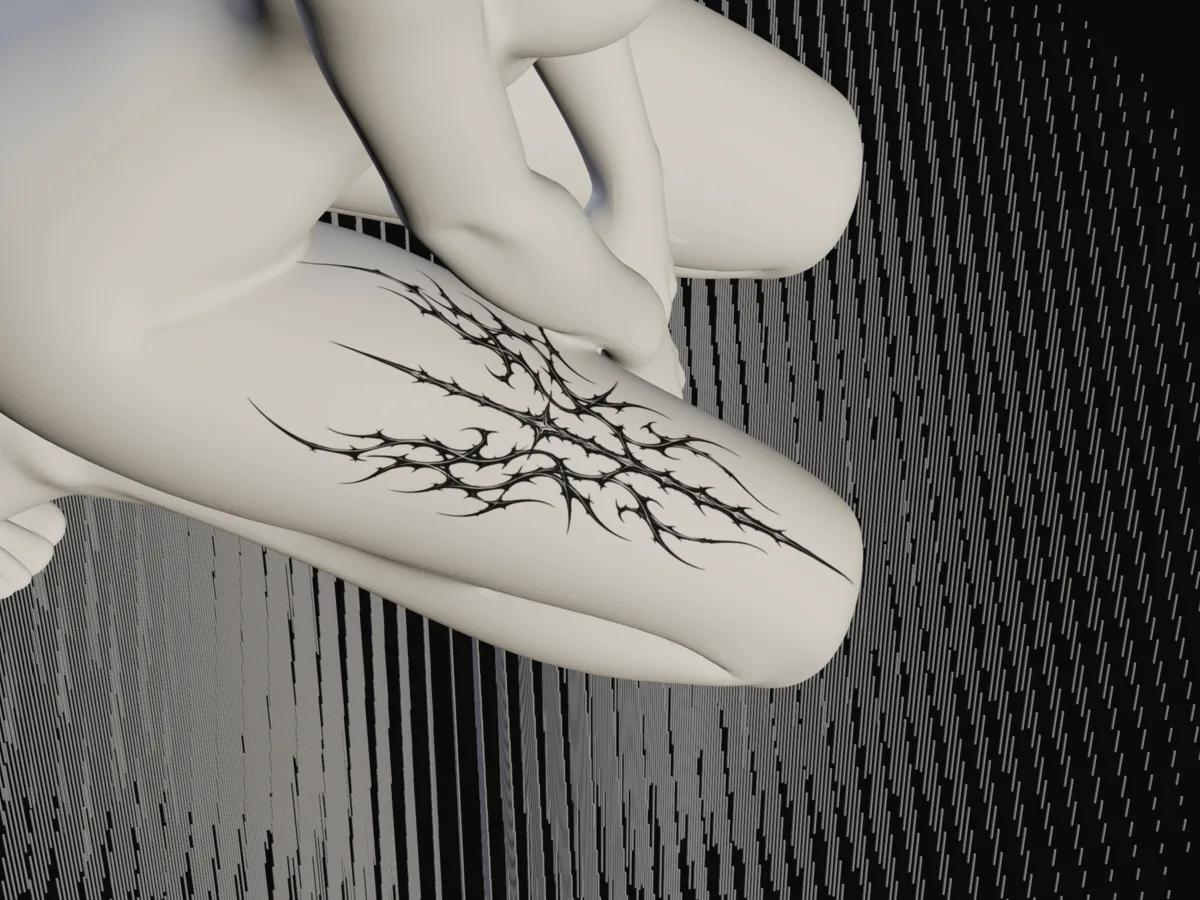
That is the worry Miami New Times heard from critics who doubt how the style will age. In the same article Lua Hills describes making it "intentionally clean but gritty". A design with hairline points packed close together has the least margin, because two lines that each double in width can meet.
Tattooers commonly advise two things for fine-line work: leave space between lines, and go bigger so the thinnest points have room. That is advice, not data.
Take one design at 5 cm and again at 12 cm: at 12 cm every line and every gap is 2.4 times as wide, and the design covers almost six times the area. The thinner a design's lines, the more that difference matters. The 5 cm tattoo and 12 cm tattoo pages cover each size in more detail.
Where to put a cybersigilism tattoo
Tattooswizard says the style works best on long, flat or gently curved parts of the body: the forearm, the calf, the spine and the sternum. There the lines can run the length of a limb or down the body's centre line. Hands, fingers and other joints that move a lot fade and blur sooner, by its account, and suit the style less.
The forearm is the usual starting point. A design can run the whole length of it. The chest gives a symmetrical piece a centre to mirror around. The back takes the biggest pieces, and the thigh has room for long ones: the piece pictured here runs 35.7 cm from the hip towards the knee.
plan.tattoo puts your design on a 3D plaster cast at the size you type in cm. You can turn the cast, move the design to another placement, try other casts, or use a posable figure to see how a design along the arm looks when the arm bends. It is free, runs in the browser, and you can try it without an account.
For a style built on old prints instead of club flyers, see the woodcut tattoo page. Credits for every sample are on the samples credits page.
Artists who work in cybersigilism
Tattooswizard names artists recognisably working in the style by the early 2020s: Awa and Sadan in Seoul, DanyKim and Umbra in France, Chainsmaiden in Argentina, Jumi Su in Berlin, Yatzil Ramirez in Mexico City and Giuliano Bolivar in Amsterdam.
Dazed features seven artists, among them Ryu (London and Paris), André Texas (London) and Jin (Seoul).
Underblast credits Aingelblood as the first to use #cybersigilism, and Tattooswizard credits the name to Aingelblood, an artist at Sekret Ink in Los Angeles. Underblast also credits Noel Garcia, who tattooed Grimes, with a major part in taking the style mainstream. Miami New Times quotes Lua Hills on keeping it "intentionally clean but gritty".
These lists come from four publications and are a starting point. Look through each artist's healed work before you book, since fine lines change the most as a tattoo ages.
Questions
Where did cybersigilism come from?
Accounts differ. Underblast credits Aingelblood with first using #cybersigilism and with originating the style, and says Aingelblood went viral on TikTok in 2020. Tattooswizard traces it to Berlin's club and rave scene in the late 2010s, and Miami New Times placed its start in New York City's tattoo scene. Behind all three sits the neo-tribal tattooing generally credited to Leo Zulueta, plus Y2K graphics and H.R. Giger.
What does cybersigilism mean?
As a style it means long, spearlike lines, symmetry and tribal-like patterns drawn with cyberpunk precision, in The Daily Beast's description of the trend, and Dazed has called it post-human or nu-tribal. Tattooswizard connects the style to Austin Osman Spare's 1913 method of turning a written intent into a glyph, while noting that most writing on cybersigilism doesn't make that connection.
Is cybersigilism the same as eurotrash?
No. Underblast describes eurotrash as a new genre born in Europe's underground tattoo scene: chaotic, sketch-style blackwork with medieval and surrealist imagery. Cybersigilism goes the other way, toward symmetry, spearlike lines and the "cyberpunk precision" The Daily Beast describes. Underblast's 23 May 2025 piece sets the two side by side, and its title treats them as separate styles.
Where do you put a cybersigilism tattoo?
Tattooswizard recommends long, flat or gently curved areas: the forearm, the calf, the spine and the sternum, where the lines can follow a limb or the body's centre line. It says hands, fingers and busy joints fade and blur sooner. Before you book, plan.tattoo puts your design on a plaster cast at its size in cm.
Sources: Grand Rapids Art Museum: Black Waves, the tattoo art of Leo Zulueta · Tattooswizard: Cybersigilism explained · Underblast: Underground tattoo takes over the world, eurotrash vs. cybersigilism (23 May 2025) · Miami New Times: cybersigilism tattoos and Gen Z (2024) · Dazed: 7 cybersigilism artists to follow now · The Daily Beast: Tattooing's biggest trend is spooky, sensual cybersigilism (13 January 2023) · Ray Studios: Why some tattoos blur over time
Open the planner, pick the thorn star in the samples and type 12 in the size, then add your own cybersigilism design from the designs panel and set it to 12 cm beside it.